COUNSELING AND EMDR THERAPY

_edited.png)
When we resist tough emotions, they don't go away. Instead, they own us, they define us…the more we try to avoid our emotions, the more control they have over our thoughts and behavior.
Brene Brown, PhD
Why Emotional Health Skills?
We spend 12 years in school, learning math, history, etc. but why don't we learn social and emotional skills? Like any skill, emotional health skills need to be taught and modeled for us to gain confidence and self-trust to navigate feelings.
Unfortunately, for many nowadays, we are shown how to maladaptively react, shame, depress or blame others for our own emotions, instead of learning how to process them.

We cannot selectively numb emotions, when we numb the painful emotions, we also numb the positive emotions.
Brene Brown, PhD
Emotional processing is #1 for nervous system regulation and mental, emotional and relational health
-
Unprocessed emotions and insecurities
-
Unprocessed core beliefs about ourselves and others
-
Leads to chronic nervous system activation and...
-
Maladaptive coping: Four F's for temporary relief
-
Only to feel painfully powerless, stuck in the blame-or-shame Trauma Triangle, grappling for a sense of power, only to end up more powerless
We need emotional processing and secure relating skills... to prevent the cycle from continuing...
.png)
Your experience of emotional pain changes relative to how you react to it. When you move toward it in an adaptive way, pain shrinks. Try to avoid it, pain grows. If you flee from it, pain pursues you like a monster in a dream.
Tony Fahkry
12 Benefits of Emotional Health Skills
-
Process even the most painful emotions
-
Process, not depress or over-express emotions
-
More 'feel good' neurochemicals, serotonin, dopamine, oxytocin
-
Think clearer, more focused
-
Processing is healing, even from trauma
-
Untangle maladaptive beliefs from emotions
-
Emotions inform of your genuine wants, needs, values
-
Emotions inform of your needed limits (boundaries)
-
Communicate your wants to get more of what you want in life
-
Connect with loved-ones in a genuine, value-aligned way
-
Leverage emotional energy for action and motivation
-
Smoother moods, less maladaptive fight, flight, freeze, fawn
-
Improves mental, emotional, relational, and physical health, including immune system, blood pressure, and digestion


Hurt feelings don't vanish on their own. They don't heal themselves... they pile up like a debt that will eventually come due.
Marc Brackett, PhD
Self-Leadership 'Wise Mind' Over Feelings, Thoughts and Beliefs
Much like our digestive process, ALL of our emotions are our own — even if influenced or triggered from an event or person! No one can make you digest food or not. No one can make you feel a certain emotion or not. Realistically and scientifically, we have 100% responsibility (power) to understand (assess genuine wants and needs) and process (metabolize) our own emotions.

Wise Mind and Emotional Health Skills
Simply put, Wise Mind is your ability to take 100% responsibility for ALL of your emotions, in order to...
-
Connect with, oversee and guide thoughts and emotions
-
Untangle thoughts from emotions (tangled together, thoughts and emotions can cause havoc, anxiety, confusion, chronic stress, depression and 'stuckness')
-
Process emotions and understand your wants and authenticity
-
Connect with you actual Self
-
Calm your nervous system
-
Remain out of the Drama Trauma Triangle

Without Wise Mind
Without Wise Mind, disconnected from bodily feelings, or trying to 'push down' 'avoid' 'think' 'change' 'gaslight yourself' or 'judge' your way through them, leaves you susceptible to:
-
Undisciplined thoughts and emotions
-
Outer Child (reactivity) or depression.
-
"Amygdala Hijack"
-
Maladaptive reactions (fight-flight-fawn-freeze)
-
Reactions can occur in seconds, seems AUTOMATIC
-
Fogged prefrontal cortex (attention)
-
Chronic stress (adrenalin and cortisol)
-
Behavioral and mood disorders
-
Chronic inflammation, medical conditions
For many, it is not an adult self directing their lives, but rather an the emotional 'inner child' inhabiting an adult body... a hurt, angry, fearful little boy or girl calling the shots.
Stephen Diamond, PhD

Wise Mind for Inner Child & Outer Child

Outer Child
Reactivity
-
Lizard brain (fight, flight, freeze)
-
Reactive, not authentically you
-
Causes havoc on our lives
-
Maladaptively trying to avoid feelings
-
Over-expressing (fight)
-
Depressing your emotions (freeze)
-
Avoiding to 'flee' emotions (flight)
-
Causing more anxiety, OCD, ADHD, addictions, depression, etc.
-
Dysfunctional relating patterns

Wise Mind
Your Balance
Oversees Thoughts & Emotions
Guides, Reasonable, Logical
-
Observes thoughts and emotions
-
Gives you power to understand and process EVERY emotional experience
-
Self-Leadership, Self-Compassion
-
Self-Discipline, Self-Secure, Self-Care
-
Discover the purpose of each emotion, your genuine wants, needed limits (boundaries), etc.
-
Also known as 'The Observing Self' in many therapy modalities

Inner Child
Emotional Mind
-
Mammalian brain
-
Authentic, genuinely "You"
-
Doesn't go away when we turn 18
-
We never 'grow-out' out of emotions
-
No right or wrong way to feel
-
"Inner Child" emotions: spontaneous, imaginative, messy, erratic, needy, temper anger, playful, etc.
-
"Inner Teen" emotions: like desire, urge to rebel, rage, etc.

Outer Child
Inner Child

Inner Child
True adulthood, security — and the capacity to love and care for yourself and others — involves taking 100% responsibility for your thoughts and emotions. For many, this never happens, which is why so many adults don't behave like adults at all, resulting in a slew of maladaptive ways of depressing, expressing or reacting to emotions.
Stephen Diamond, PhD
Examples of Inner and Outer Child
INNER CHILD / EMOTIONAL MIND
Feelings and Emotions
Present Experience
Feels overwhelmed with too much work.
Feels anxious and inferior at a social gathering.
Feels angry because friend is 20 minutes late.
Feels jealous when husband talks to coworker at work event.
Feels angry about not getting a promotion even though due for one after years of proven success.
OUTER CHILD / REACTIVITY
Impulsivity and Reactions
Acts out Emotions
Procrastinates, rebels, fails to do any work.
Overdrinks and overshares personal information.
Scowls angrily and gives silent treatment.
Tells husband about feeling jealous and not feeling pretty enough.
Seethes and feels 'powerless' (depression) for years and finally sends angry email to boss complaining about not being valued
Emotions have information. when we pay attention to them they give us useable data - which could be a comfort for those of you who might believe that the whole 'feeling thing' is too airy-fairy.
Julia Colwell, PhD
Emotional Literacy: Primary Emotions

EVERY EMOTION HAS A PURPOSE
You may be surprised to learn that every emotion has a distinct message and purpose.
EMOTIONS CHANGE EMOTIONS
Hundreds of recent studies prove how certain emotions like SELF-COMPASSION, CURIOSITY and GRATITUDE help us:
-
Process painful emotions and feel better
-
Heal attachment disorders, PTSD, depression, anxiety disorders and more
-
Understand your emotions so you're aligned with your genuine wants and needs


The goal of Self-Compassion practice is to become a compassionate mess. All of our issues - like entitlement, anger, and self-loathing will be there, but can we hold them with compassion so we're not overwhelmed by them.
Kristin Neff, PhD
Emotions are Neurochemicals and Hormones

HAPPY / CALM IS FULL BODY
-
Happy is a full-body state of calm
-
We are meant to be calm, safe and with a 'Sense of Belonging' unless there is an immediate threat to our safety or connection needs
-
Sometimes in order to be calm and happy, we need to 'feel through' (process) our PROTECTIVE EMOTIONS.
PROTECTIVE EMOTIONS
-
ANGER: blame, resentment, etc. (purpose: protection, boundaries, values)
-
SAD: hurt, disappointment, etc. (purpose: healing, releasing, rejuvenation)
-
FEAR: worry, jealousy, anxiety, etc. (purpose: future-focus, safety, planning)
-
SHAME: self-blame, regrets, should's, bad, etc. (purpose: belonging, moral compass)
ENERGIZING EMOTIONS
-
INTEREST: curious, want, desire, valuing, etc.
-
PASSION: motivated, creative, excited, etc.
Delivering the body from functioning as a storage room for suppressed emotions brings a sense of natural love and ease, a spaciousness, that we commonly call happiness.
Somesh Curti, PhD
Thoughts vs Emotions
Thoughts are Like a Map of a Town
Much like a map, thoughts stem from the past to help guide us
-
Thoughts stem from our past or what we've learned from others
-
Thoughts can be lessons-learned and future what-if's and planning
-
Much of what we say we feel, are really thoughts/beliefs. "I feel you're unfair." "I feel stupid." "You hurt my feelings." These are thoughts/beliefs!
-
Indirect, not the true essence of who we are in present moment
-
Not always rational nor factual
-
Although thoughts are, of course, incredibly useful!
-
Can tell you your core beliefs

Emotions are Being in the Town Real Time
If you want to know how you feel, how do you feel about it right now?
-
Direct links to your present, authenticity
-
Neurochemicals and hormones felt physiologically throughout the body
-
Based on real or perceived events, thoughts or beliefs
-
Can trigger and entangle with thoughts/beliefs, leading to opinions, beliefs, perceptions, based on past experiences (this has pros and cons)
-
Inform you, "inner compass" of genuine wants, values, needed limits (boundaries)
-
Just as hunger motivates to find food, emotions motivate for other needs, like safety and connection
-
Fuel, ignite blood flow, vigilance, attention, and other physiological reactions to flee from danger, accomplish tasks, align with values, connect with loved-ones
-
ALWAYS 'on' even though subtle at times

Nobody is responsible for your own sadness except for you. Nobody is responsible for your fear except you. You are the only person responsible for any and all of your emotions... positive, negative, and everything in between.
Chris Cade
Nervous System Chart
Learn more about the Emotional Nervous System with Polyvagal Therapy and Nervous System Science for a more thorough understanding of Emotional and Mental Health and Self-Leadership Skills.
.png)
Attend to depression in a grounded, empathetic way. It can stand up for your lost dreams and clear everything inside that threatens those dreams. In essence, giving you a new life.
Karla McLaren, MEd
Emotion Videos
If we don't unpack shame, we cannot reach our core of worthiness and self-love. Things like positive affirmations are useful but they are temporary support to balance negative judgments, like painkillers to diminish the pain temporarily without addressing the cause - in this case, suppressed shame.
Somesh Curti, PhD
Worksheets and Practices
EMOTIONAL HEALTH SKILLS


PROCESSING EMOTIONS


We can't just choose to be happy, but we can choose to be kind ourselves when we're sad. Pain passes more quickly when we don't berate ourselves for feeling.
Lori Deschene



Chronic Nervous System Activation Stress and Maladaptive Coping
Nervous System Informed IFS Therapy
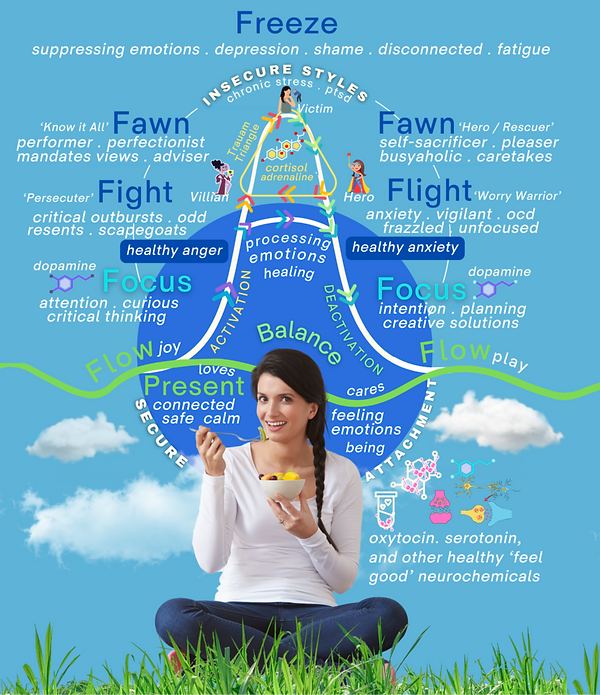
Learn how to get unstuck from automatic reactions and behaviors, activated and triggered emotions, automatic assumptions, insecurities, thoughts and limiting beliefs and relational patterns that impact your nervous system, both causes and effects.
-
Neurochemicals and Symptoms
-
Core Beliefs and Trauma Triangle Patterns
-
Maladaptive Reactions Fight, Flight, Freeze, Fawn
-
Secure Sense of Self vs Insecurities
-
Secure Attachment vs Insecure Attachment
_edited.png)
When repeatedly criticized, ignored or traumatized in childhood, we learn to survive by over-relying on the use of one or two of the 4F's. This severely impairs our ability to relax into an undefended state, circumscribing us to a very narrow, impoverished experience of life.