COUNSELING AND EMDR THERAPY

_edited.png)
Self-Worth and Secure Relating: Break Free of Maladaptive Triangle Patterns and Roles
Gain awareness and skills that bring you out of conflict, power-struggles, abuse cycles, codependency, resentment, insecurities, depression, disconnection and confusion, and into more confidence, clarity and secure connection.
At the root of every conflict are unmet needs. If you are in conflict, power struggle or relational distress you are in the Drama Triangle.
Julia Colwell, PhD
Resolving Triangle Patterns, Insecurities and Maladaptive Roles
The Trauma Triangle (aka Drama Triangle, Abuse Cycle, Codependency Triangle, Narcissistic, Victim Triangle) provides a visual of how we fall into 3 roles and a myriad of 'getting' and 'protecting' beliefs and patterns (Four Fs).
Starting in childhood, we absorb these roles, and maladaptive and adaptive roles, through family, relational and social experiences. Keep in mind, we learn in three ways, by (1) what's modeled for us (subconscious programming), (2) trial and error (learning from mistakes) or (3) intentional, like from a book, research, class or through therapy.
Maladaptive core roles and triangle patterns are on a spectrum of moderate to severe. Stemming from mild maladaptive coping to societal expectations and childhood emotional neglect to severe developmental trauma and abuse.

You don't have to be in conflict to be in the Triangle. We live in it subconsciously. Not because we like to be victims, rescuers or critics. We think the only way to keep people close is trying [maladaptive] ways to get our wants or needs met without telling the truth about our wants or needs.
Heidi Priebe
The Triangle: Three Core Roles
Three Core Roles
-
Rescuer/Hero
-
Villain/Critic/Know-it-All
-
Victim/Hurt (everyone in the Triangle inevitably ends up hurt due to not doing or communicating needs and wants with 'I want ____ ')
Although it seems simple at first, the Triangle results in complex maladaptive patterns (the Four F's), chronic nervous system activation (complex-PTSD) and anxiety, depression, insecurities and painful stress chemicals like cortisol.
It makes it difficult, even impossible to get secure connection (feeling seen, heard and valued/worth for real), self-worth, and 'feel good' neurochemicals like serotonin and oxytocin.
Cause and effect of conflict, insecurities, insecure attachment styles (anxious, avoidant, disorganized attachment styles and Borderline Personality Disorder) and Codependent/Narcissistic dynamic.
.png)
With secure relating skills, our needs, preferences and requests are stated explicitly. Whereas in the Triangle there's this eternal game of trying to get your needs met without explicitly stating what your needs and wants are.
Heidi Priebe
Short Term Conflict
-
A person plays a role, like
-
Hero giving unsolicited advice or help
-
Critic giving unsolicited 'rightness' or criticism
-
Victim defending, explaining, complaining or blaming
-
-
Other person jumps into a role, usually to defend and conflict begins
-
Only one person can occupy a role at a time
-
We swap roles, looping in the Triangle trying to 'win our case' defending or explaining how hurt or harmless (Victim), good or helpful (Hero), or right (Critic) we are
-
Everyone inevitably ends up in the Hurt/Victim role

The Triangle and Victim Consciousness involves a set of beliefs and feelings at the core of a culture and learned in family of origin. It's wired into you. However once aware, you can debunk the thoughts, feelings and beliefs that trap you.
Barry Weinhold, PhD
Long Term Patterns
-
Without awareness, stuck in the Triangle for years
-
Repeating, only to feel devalued, unloved, resentful, insecure and chronic stress
-
Lack of real connection (feeling seen, heard and valued/appreciated)
-
Lack of 'feel good' neurochemicals like oxytocin and serotonin
-
Chronic painful emotions and stress chemicals, like cortisol
-
Only short bursts of connection when "playing a role" in the Triangle instead of feeling genuine, long-term value and lovability
-
Cause and effect of maladaptive 'getting' and 'protecting' patterns (Four Fs: Fight, Flight, Freeze, Fawn)
-
Codependency, conflict, controlling, people-pleasing, angry outbursts, resentment, self-medicating, addiction, etc.
-
Dysfunctional, even abusive relationship with self and others
-
Confusion, dissociation, inability to feel or make decisions
-
Failure to get wants met in relationships and overall, due to the lack of feeling wants and communicating wants clearly
-
Resulting mental, emotional and physical health disorders

If you play any of the Drama Triangle roles you will end up feeling hopeless and helpless.
Tyler Rich LMFT
Self-Leadership 'Wise Mind' Over Feelings, Thoughts and Beliefs
Much like our digestive process, ALL of our emotions are our own — even if influenced or triggered from an event or person! No one can make you digest food or not. No one can make you feel a certain emotion or not. Realistically and scientifically, we have 100% responsibility (power) to understand (assess genuine wants and needs) and process (metabolize) our own emotions.

Wise Mind and Emotional Health Skills
Simply put, Wise Mind is your ability to take 100% responsibility for ALL of your emotions, in order to...
-
Connect with, oversee and guide thoughts and emotions
-
Untangle thoughts from emotions (tangled together, thoughts and emotions can cause havoc, anxiety, confusion, chronic stress, depression and 'stuckness')
-
Process emotions and understand your wants and authenticity
-
Connect with you actual Self
-
Calm your nervous system
-
Remain out of the Drama Trauma Triangle

Without Wise Mind
Without Wise Mind, disconnected from bodily feelings, or trying to 'push down' 'avoid' 'think' 'change' 'gaslight yourself' or 'judge' your way through them, leaves you susceptible to:
-
Undisciplined thoughts and emotions
-
Outer Child (reactivity) or depression.
-
"Amygdala Hijack"
-
Maladaptive reactions (fight-flight-fawn-freeze)
-
Reactions can occur in seconds, seems AUTOMATIC
-
Fogged prefrontal cortex (attention)
-
Chronic stress (adrenalin and cortisol)
-
Behavioral and mood disorders
-
Chronic inflammation, medical conditions
Short Term Conflict
-
A person plays a role, like
-
Hero giving unsolicited advice or help
-
Critic giving unsolicited 'rightness' or criticism
-
Victim defending, explaining, complaining or blaming
-
-
Other person jumps into a role, usually to defend and conflict begins
-
Only one person can occupy a role at a time
-
We swap roles, looping in the Triangle trying to 'win our case' defending or explaining how hurt or harmless (Victim), good or helpful (Hero), or right (Critic) we are
-
Everyone inevitably ends up in the Hurt/Victim role

Anytime we take less than 100% personal responsibility for our own emotions, beliefs, assumptions, words and behaviors, we are in the Victim [Hurt] position.
Julia Colwell, PhD

Wise Mind for Inner Child & Outer Child

Outer Child
Inner Child

Inner Child

Hero
Power Over
-
Unsolicited advice/help
-
I'm sorry you _________
-
You poor thing.
-
You must tell me your thoughts, feelings, etc.
-
Sound parental (caretaking)
-
Apologizing when not directly at fault
-
Over 100% responsible
-
Exhausted, anxious, resentful
-
Hypervigilant, mind-reading instead of taking others words at face value
-
Assuming you know others needs and wants (or what's best for them) instead of asking
-
Quickly slips into the Villain/Critic Role as unsolicited advice/help is similar to unsolicited criticism/opinions

Wise Mind
Your Balance
Oversees Thoughts & Emotions
Guides, Reasonable, Logical
-
Unsolicited criticism/opinions
-
You should/shouldn't _______
-
You're wrong about _______
-
You _______ (opinion about you)
-
Why do/are you _______
-
Sound parental (critical)
-
Stern, aggressive or abusive
-
Mandating values, beliefs, perceptions on others
-
Bossy, critical, controlling, picky, distrusting or opinionated
-
Assuming you know others needs and wants (or what's right) instead of asking
-
Typically well-intentioned and likely feels they are in the 'Hero Role' without realizing that they've slipped into Villain

Inner Child
Emotional Mind
-
You make me feel _________
-
You do/don't _________
-
They/It made me ________
-
JADE-ing (justifying, arguing, defending, explaining)
-
Complaining (rather than communicating wants and needs)
-
Blaming/Scapegoating anything or anyone (people, politics, weather, substances, habits, addictions, ADHD, anxiety, bad luck, etc.)
True adulthood, security — and the capacity to love and care for yourself and others — involves taking 100% responsibility for your thoughts and emotions. For many, this never happens, which is why so many adults don't behave like adults at all, resulting in a slew of maladaptive ways of depressing, expressing or reacting to emotions.
Stephen Diamond, PhD
Emotional Literacy: Primary Emotions

EVERY EMOTION HAS A PURPOSE
You may be surprised to learn that every emotion has a distinct message and purpose.
EMOTIONS CHANGE EMOTIONS
Hundreds of recent studies prove how certain emotions like SELF-COMPASSION, CURIOSITY and GRATITUDE help us:
-
Process painful emotions and feel better
-
Heal attachment disorders, PTSD, depression, anxiety disorders and more
-
Understand your emotions so you're aligned with your genuine wants and needs


The goal of Self-Compassion practice is to become a compassionate mess. All of our issues - like entitlement, anger, and self-loathing will be there, but can we hold them with compassion so we're not overwhelmed by them.
Kristin Neff, PhD
Emotions are Neurochemicals and Hormones

HAPPY / CALM IS FULL BODY
-
Happy is a full-body state of calm
-
We are meant to be calm, safe and with a 'Sense of Belonging' unless there is an immediate threat to our safety or connection needs
-
Sometimes in order to be calm and happy, we need to 'feel through' (process) our PROTECTIVE EMOTIONS.
PROTECTIVE EMOTIONS
-
ANGER: blame, resentment, etc. (purpose: protection, boundaries, values)
-
SAD: hurt, disappointment, etc. (purpose: healing, releasing, rejuvenation)
-
FEAR: worry, jealousy, anxiety, etc. (purpose: future-focus, safety, planning)
-
SHAME: self-blame, regrets, should's, bad, etc. (purpose: belonging, moral compass)
ENERGIZING EMOTIONS
-
INTEREST: curious, want, desire, valuing, etc.
-
PASSION: motivated, creative, excited, etc.
Delivering the body from functioning as a storage room for suppressed emotions brings a sense of natural love and ease, a spaciousness, that we commonly call happiness.
Somesh Curti, PhD
Thoughts vs Emotions
Hero
-
Unsolicited advice/help
-
I'm sorry you _________
-
You poor thing.
-
You must tell me your thoughts, feelings, etc.
-
Sound parental (caretaking)
-
Apologizing when not directly at fault
-
Over 100% responsible
-
Exhausted, anxious, resentful
-
Hypervigilant, mind-reading instead of taking others words at face value
-
Assuming you know others needs and wants (or what's best for them) instead of asking
FEELS LIKE
-
Urge to 'blend' and 'save' others from emotions (enmeshing)
-
Over-responsible, resentful, exhausted, anxious, burdened or parental
-
Despise feeling guilt or 'not needed'
-
Tend to feel taken advantage of and CODEPENDENT
-
Incessant need to 'help' others, even when others need to be responsible for themselves (enabling)
-
Hypervigilant, mind-reading instead of taking others words at face value
-
Assuming you know others needs and wants instead of asking
-
Don't recall knowing or clearly stating your real needs and wants yet expect others to know (and if they don't you feel unloved and in Hurt)

.png)
Peacemaker
ANXIETY
Responsible for keeping the peace as an intermediary, a go-between, and a mediator
to prevent or pacify other
family members’ conflict,
irritability, anger or other
emotions. Felt responsible
for others’ emotions and
well-being (emotional
enmeshment).
.png)
Parental Child
REACT AT
Drafted into the practical aspects of running a household, or assumes responsibility caring for younger siblings
and/or under-functioning parents (loving, well-intentioned parents can go through difficulties, illnesses, heartbreak, and other stressors). Acutely aware of others’ wants and needs, instead of their own.

Hero / "Rock"
COMPLIANT
Family points to as solid
example of family doing
well. Gets good grades, star athlete or other shining accomplishments. There are many gifts to this role! Yet there are serious downsides that often go unnoticed until adulthood, involving lifelong insecurities due to underlying beliefs that self-worth is attached to achievements or rescuing.
_edited.jpg)
Freeze
DEPRESSION
ATS auto-detects uncomfortable emotions and situations as 'severe threats!' Results in brainfog, overwhelm, denial, procrastination, ADD, depression, fatigue.
Invisible Child
ANXIETY
Attempts to blend into
the background to feel
safe and avoid rocking the
(sinking) boat. Feel
ignored, neglected, and
scared to draw attention to themselves, especially in abusive households. Parents may use them, like the hero role, to exemplify how great
the family is doing, since
they are quiet, ‘harmless’ and not causing any trouble.
Dependent Child
REACT AT
Held in an extended or
exaggerated child-like
position, over-protected,
enabled or taught to feel
helpless/powerless. May
occur due to parents’
guilt over circumstances
(working overtime, divorce, or over adaptation to their own difficult or emotional neglected childhood). May turn into Identified Patient
Identified Patient
COMPLIANT
The ‘disordered,’ ‘patient’
or ‘addict’ represents the
culmination of the family’s
issues. As a child this role
is internalized as a core
belief. As an adult, this
family member continues
to serve as a distraction
(sacrificial) from the family’s issues, as the family rallies to get ‘help’ for this ‘hurt’ or ‘disordered’ family member. The perpetual ‘victim consciousness’ and ‘rescuing’ complex between child and parent is catostrophic.
Freeze
DEPRESSION
ATS auto-detects uncomfortable emotions and situations as 'severe threats!' Results in brainfog, overwhelm, denial, procrastination, ADD, depression, fatigue.
Stage 1: Magical Thinking
Lack cause-and-effect thinking and often act on their impulses
Often blame things that happen as "magical"
Typically blame conflicts on someone or something else
Stage 2: Concrete Thinking
Limited to addressing only what is tangible, visible and obvious aspects of conflicts
Unable to grasp abstract concepts, such as justice, freedom, boundaries
Quick to temper but less likely to hold grudges
Stage 3: Cross Relational Thinking
-
Can think abstractly, seeing relationships between information but still see the world as acting on them or to them
-
All-or-nothing thinking, believe people are 'good' or 'bad,' lovable or not
-
Feeling 'bad'' (shame) is put on others labeling them as 'bad' in order to feel 'good' by trying to convince others they are bad, wrong, etc "You ____."
-
Stuck in Triangle to feel, think, sound and act out victims or victimizer roles
Stage 4: Systemic Thinking
-
Think holistically and recognize patterns of thoughts, feelings and behaviors
-
Can listen with curiosity, reflect internally, feel responsibility (healthy shame)
-
See how the past contributes to current conflict but tend to feel over-responsible
-
Thus stuck in self-berating, inner criticism (shame) and regret from the past
Stage 5: Trans-Systemic Thinking
-
Think holistic with Wise Mind (insight and oversight) over thoughts and feelings
-
Recognize 100% responsibility (healthy shame) for own actions, emotional processing, identifying wants, needs, purpose and communicate as needed
-
Recognize other adults are 100% responsible for their own thoughts, feelings, behaviors and communicating their own wants and needs
-
Can listen with curiosity, reflect internally, feel responsibility (healthy shame)
-
Can collaborate, creative solutions, feel self-forgiveness with lessons learned

Flight
ANXIETY
Reacting to feelings by trying to escape or avoid them by over-working, perfecting, hyper-independence, etc. Results in anxiety, OCD, ADHD and process addictions.
Fight
REACT AT
Reacts to emotions as if they're 'threats' they're powerless over. Tries to get power back by boundarylessly expressing words, demands, blame, complaints or actions at.
Fawn
COMPLIANT
Overrides feelings by taking on 200% power with self-blame with people-pleasing, codependency, over-giving, minimizing others' letdowns and abuse.
Freeze
DEPRESSION
ATS auto-detects uncomfortable emotions and situations as 'severe threats!' Results in brainfog, overwhelm, denial, procrastination, ADD, depression, fatigue.
Nobody is responsible for your own sadness except for you. Nobody is responsible for your fear except you. You are the only person responsible for any and all of your emotions... positive, negative, and everything in between.
Chris Cade
Nervous System Chart
Learn more about the Emotional Nervous System with Polyvagal Therapy and Nervous System Science for a more thorough understanding of Emotional and Mental Health and Self-Leadership Skills.
.png)
Attend to depression in a grounded, empathetic way. It can stand up for your lost dreams and clear everything inside that threatens those dreams. In essence, giving you a new life.
Karla McLaren, MEd
Emotion Videos
If we don't unpack shame, we cannot reach our core of worthiness and self-love. Things like positive affirmations are useful but they are temporary support to balance negative judgments, like painkillers to diminish the pain temporarily without addressing the cause - in this case, suppressed shame.
Somesh Curti, PhD
Worksheets and Practices
EMOTIONAL HEALTH SKILLS


PROCESSING EMOTIONS


We can't just choose to be happy, but we can choose to be kind ourselves when we're sad. Pain passes more quickly when we don't berate ourselves for feeling.
Lori Deschene



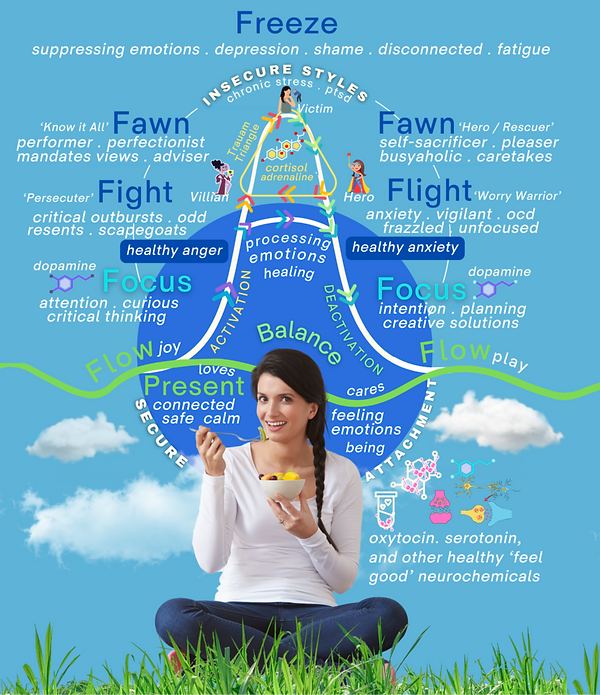
Chronic Nervous System Activation Stress and Maladaptive Coping
Nervous System Informed IFS Therapy
Learn how to get unstuck from automatic reactions and behaviors, activated and triggered emotions, automatic assumptions, insecurities, thoughts and limiting beliefs and relational patterns that impact your nervous system, both causes and effects.
-
Neurochemicals and Symptoms
-
Core Beliefs and Trauma Triangle Patterns
-
Maladaptive Reactions Fight, Flight, Freeze, Fawn
-
Secure Sense of Self vs Insecurities
-
Secure Attachment vs Insecure Attachment
_edited.png)
When repeatedly criticized, ignored or traumatized in childhood, we learn to survive by over-relying on the use of one or two of the 4F's. This severely impairs our ability to relax into an undefended state, circumscribing us to a very narrow, impoverished experience of life.